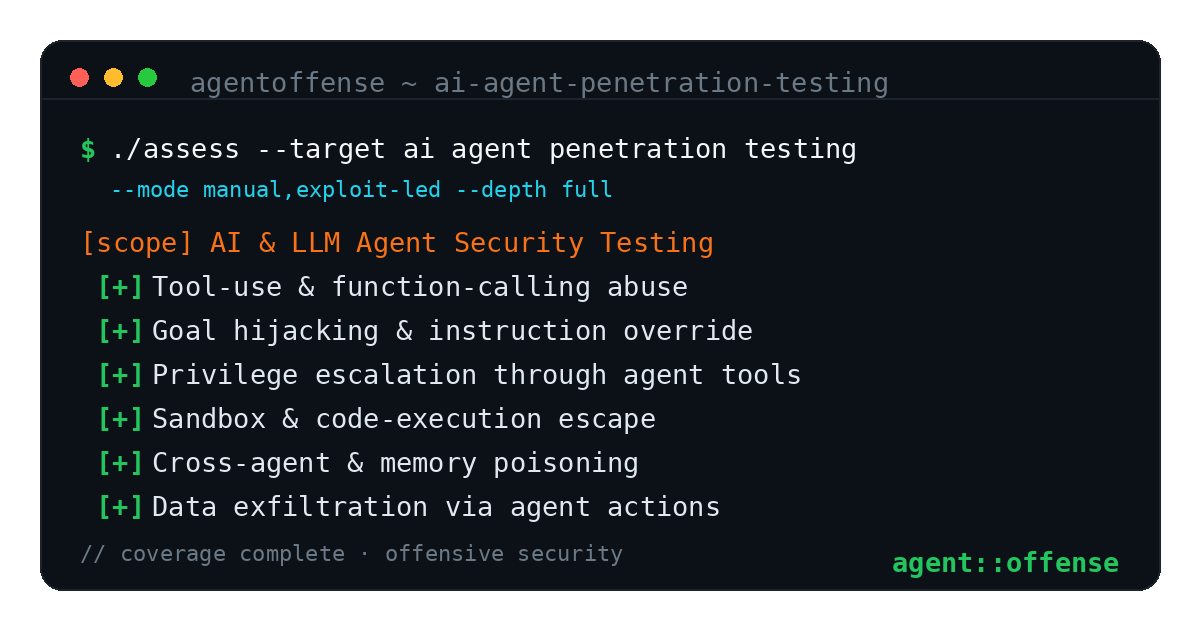
An AI agent that can browse, run code or move data becomes an insider the moment it ingests attacker-controlled input. Our AI agent penetration testing assesses autonomous and agentic systems end to end — the model, its tools, its memory and the boundaries between them.
We attempt tool-use abuse, goal hijacking, privilege escalation and sandbox escape to show exactly what a compromised agent could do inside your environment.
Our AI agent security testing covers the full agentic stack: the underlying LLM, the system prompt, the tool and function-calling layer, agent memory and state, and any multi-agent orchestration. We assess single-agent assistants and complex multi-agent systems built on LangChain, LlamaIndex, AutoGen, CrewAI, Semantic Kernel or bespoke frameworks, and we test both cloud-hosted and self-hosted models. Whether you are shipping an autonomous customer agent, an internal copilot with tool access, or an AI-driven automation pipeline, we show precisely how an attacker could turn it against you.
AI Agent Penetration Testing: manual, exploit-led coverage — web, API, cloud, network and AI-agent security.
Why it matters
Autonomous AI agents are rapidly moving from demos into production, where they hold API keys, execute code and act on behalf of users. A single successful prompt injection or tool-abuse chain can turn that helpful agent into an insider threat operating with its full privileges — making AI agent penetration testing essential before deployment.
Unlike a chatbot that only returns text, an agent takes real actions. That fundamentally raises the stakes: the impact of a compromise is measured in transactions executed, data exfiltrated and systems reached, not just in a bad answer.
What we test
Tool-use & function-calling abuse
Goal hijacking & instruction override
Privilege escalation through agent tools
Sandbox & code-execution escape
Cross-agent & memory poisoning
Data exfiltration via agent actions
Common vulnerabilities we uncover
Tool-use abuse leading to unauthorized actions
Goal hijacking via injected instructions
Excessive agency and over-broad tool permissions
Sandbox and code-interpreter escape
Cross-agent memory and context poisoning
Sensitive data exfiltration through agent tools
Our methodology
Scoping & rules of engagement. We agree objectives, targets and boundaries for your ai agent penetration testing, so testing is safe, authorized and focused on what matters to your business.
Reconnaissance & mapping. We enumerate the full attack surface in scope, building a complete picture before any exploitation begins.
Manual exploitation. Our senior testers chain vulnerabilities by hand — going far beyond automated scanners — to prove real, demonstrable impact.
Analysis & reporting. Every finding is triaged, risk-rated with CVSS and written up with a copy-paste reproduction and clear remediation.
Remediation support & free retest. We support your team through the fixes and retest the remediated issues to confirm they are genuinely closed.
Tools & techniques
We test AI agents with a blend of manual adversarial prompting, custom tooling and framework-aware instrumentation. Our engineers craft bespoke injection and tool-abuse payloads, intercept and manipulate the agent's tool calls and function-calling traffic, and inspect agent memory, state and inter-agent messaging. We use our in-house agent red-team harness to run structured suites of prompt-injection, goal-hijack and sandbox-escape scenarios, and we combine this with traditional web, API and infrastructure testing of the systems the agent can reach.
When you need this engagement
Before launching an autonomous or tool-using AI agent to production
When an agent is granted access to sensitive data, code execution or payments
As part of AI governance, risk and compliance (NIST AI RMF, EU AI Act) programs
After integrating third-party tools, plugins or MCP servers into an agent
What you receive
Agent threat model & attack map
Exploitation PoCs with impact
Guardrail & tool-scope recommendations
Free retest after remediation
What’s included in your report
Every ai agent penetration testing engagement concludes with a comprehensive, board-ready report and a working session to walk your team through it. Your report includes:
An executive summary with overall risk posture for non-technical stakeholders
Detailed technical findings, each with a step-by-step, copy-paste reproduction
CVSS v3.1 severity ratings and business-impact context for every issue
Prioritized, actionable remediation guidance your engineers can apply directly
A complimentary retest to confirm fixes and update finding status
A formal attestation letter for customers, auditors and compliance programs
Standards & frameworks
OWASP LLM Top 10OWASP Agentic ThreatsMITRE ATLASNIST AI RMF
Outcomes you can expect
After your ai agent penetration testing, you will have clear, evidence-based visibility into your real security risk — not a scanner’s guesswork. You will know exactly which weaknesses an attacker could exploit, what the business impact would be, and the precise steps to fix them in priority order. Teams use our findings to close critical gaps, satisfy customer and regulator security requirements, and demonstrate due diligence to their board. With a complimentary retest included, you also get documented proof that the issues are genuinely resolved.
Engagement details & logistics
Every ai agent penetration testing starts with a short, no-obligation scoping call to understand your goals, environment and constraints, followed by a fixed-price proposal and a clear statement of work. Most engagements are delivered fully remotely, with on-site work arranged where it genuinely adds value. Throughout testing we maintain an agreed communication cadence and escalate any critical, high-impact finding to you immediately rather than waiting for the final report. All work is performed under a signed NDA with strict data-handling controls, using safe, non-disruptive techniques and carefully coordinated rules of engagement to protect your production systems. On completion you receive your report and a walkthrough session, followed by a complimentary retest once your fixes are in place. Typical engagements are booked one to three weeks in advance, and urgent or pre-deadline testing can often be accommodated — just ask at hi@agentoffense.com.
Why organizations choose AgentOffense
Our ai agent penetration testing is delivered by senior offensive-security engineers who test the way real attackers do — manually, creatively and with a relentless focus on proving genuine, demonstrable impact. Here is what sets our engagements apart:
Manual, exploit-driven testing that chains vulnerabilities the way a real attacker would, going far beyond what automated scanners can find.
Reproducible proof for every finding, with copy-paste reproduction steps your engineers can follow and independently verify.
Honest severity calibration so you invest in fixing what genuinely matters and avoid wasting effort on false positives and noise.
Clear, business-focused reporting that speaks to engineers and executives alike, tying every issue to real-world impact.
A complimentary retest included, so you get documented proof that your fixes actually close the attack path.
Responsible, collaborative delivery with a named point of contact and secure handling of all data throughout the engagement.
Explore related services
AI Agent Penetration Testing is frequently scoped alongside our other offensive-security services for broader coverage. Explore related engagements that complement it:
Prompt Injection Testing — Prompt injection testing — direct and indirect injection across every untrusted input path, including RAG and…
MCP Server & Tool-Chain Security Testing — MCP server security testing — tool schema tampering, confused-deputy paths, credential-scope leakage and abuse of Model…
Agentic AI Threat Modeling — Agentic AI threat modeling — structured analysis of autonomous agent workflows, trust boundaries and abuse cases…
Related product from AgentOffense
Our offensive research feeds products you can run yourself — tools that complement ai agent penetration testing:
Every ai agent penetration testing is scoped and priced individually, so you pay for exactly the coverage you need — with no hidden extras. After a short, no-obligation scoping call we send a fixed-price quote, usually within one business day, with clear deliverables, a firm timeline and a complimentary retest included. The price of your ai agent penetration testing depends on the size and complexity of the target and the depth of testing required, so you always know the cost up front before any work begins.
Agents take autonomous actions with real permissions based on natural-language input. Untrusted text becomes a control channel, which breaks assumptions traditional testing doesn't account for.
Do you test frameworks like LangChain or MCP-based agents?
Yes. We test custom agents and popular frameworks, and offer dedicated MCP tool-chain testing for Model Context Protocol integrations.
Can you test without disrupting production agents?
Yes. We typically test against a staging deployment and coordinate closely to avoid unintended actions in production.
What kinds of AI agents do you test?
Customer-facing autonomous assistants, internal copilots, coding agents, RPA-style workflow agents and multi-agent systems built on frameworks like LangChain, LlamaIndex, AutoGen, CrewAI or custom orchestration.
What deliverables prove the impact?
Each finding includes the exact input sequence, the unauthorized action the agent took, and the resulting business impact — so engineering and leadership both see concrete risk, not theory.
How much does AI agent penetration testing cost?
Cost depends on the number of agents, tools and integrations in scope. We provide a fixed-price quote after a short scoping call — reach out at hi@agentoffense.com.
Do you test agents built on OpenAI, Anthropic or open-source models?
Yes. We test agents built on OpenAI, Anthropic Claude, Google Gemini, Azure OpenAI, AWS Bedrock and self-hosted open-source models such as Llama and Mistral.
How long does an AI agent penetration test take?
Most engagements run one to three weeks depending on the number of agents, tools and integrations, plus a retest window after fixes.
Will you need access to our source or prompts?
Black-box testing is possible, but graybox access to system prompts, tool definitions and architecture finds deeper, higher-impact issues faster and is strongly recommended.
// get started
Request AI Agent Penetration Testing
Tell us about your target and goals. We’ll reply with scope and a fixed-price quote — usually within one business day.
./request_engagement
We use only essential cookies needed to run this site. See our Privacy Policy.