Our web application penetration testing simulates a determined attacker against your web app — authenticated and unauthenticated, across every role and workflow. We combine deep manual testing with targeted tooling to find the flaws scanners miss: broken access control, injection, authentication bypasses and business-logic abuse.
You get a prioritized report with copy-paste reproduction steps, real-world impact for each finding, and remediation guidance your developers can act on immediately.
Our web application penetration testing covers modern single-page apps, server-rendered applications, progressive web apps and their supporting APIs. We test across every user role and workflow — authentication, authorization, session management, input handling, file uploads, payments and business logic — using the OWASP Web Security Testing Guide extended with manual tradecraft for chained exploits. Whether you run a SaaS platform, an e-commerce store or an internal enterprise app, we uncover the access-control and business-logic flaws that automated scanners consistently miss.
Web Application Penetration Testing: manual, exploit-led coverage — web, API, cloud, network and AI-agent security.
Why it matters
Web applications remain the single most common entry point for breaches, exposing authentication, business logic and sensitive data directly to the internet. Automated scanners catch a fraction of real risk — broken access control and business-logic abuse, the two most damaging categories, require a human attacker to find.
A thorough web application penetration test proves which weaknesses actually chain into compromise, giving you defensible evidence and a prioritized path to fix what matters.
What we test
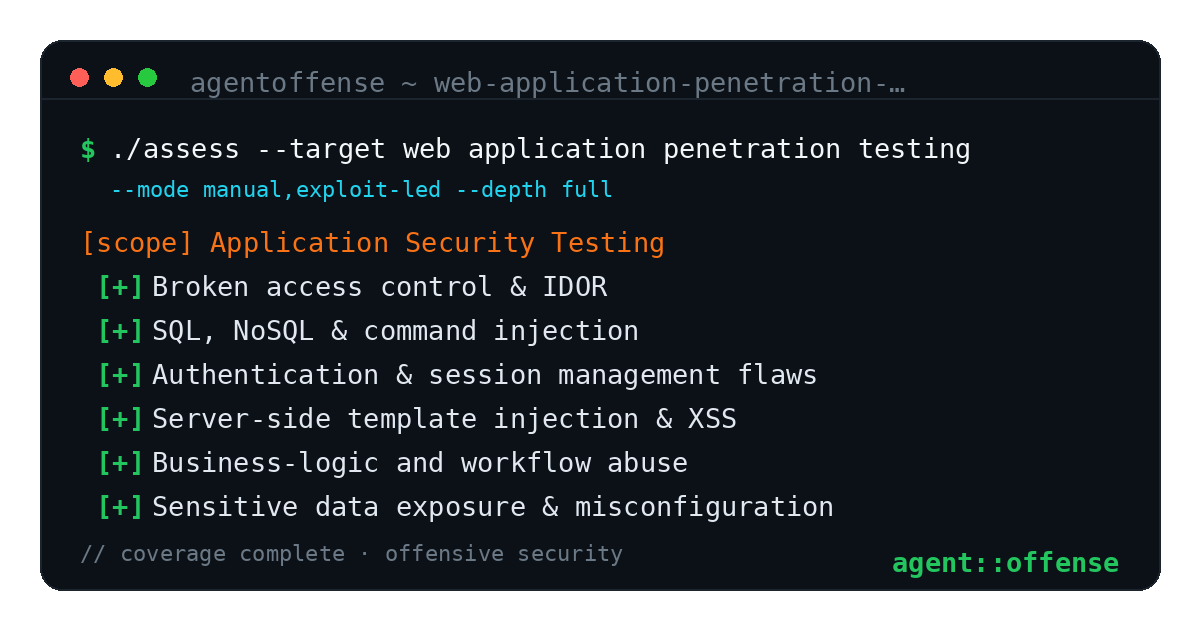
Broken access control & IDOR
SQL, NoSQL & command injection
Authentication & session management flaws
Server-side template injection & XSS
Business-logic and workflow abuse
Sensitive data exposure & misconfiguration
Common vulnerabilities we uncover
Broken access control and IDOR
SQL, NoSQL and command injection
Cross-site scripting (XSS) and SSTI
Authentication and session management flaws
Business-logic and workflow abuse
Security misconfiguration and data exposure
Our methodology
Scoping & rules of engagement. We agree objectives, targets and boundaries for your web application penetration testing, so testing is safe, authorized and focused on what matters to your business.
Reconnaissance & mapping. We enumerate the full attack surface in scope, building a complete picture before any exploitation begins.
Manual exploitation. Our senior testers chain vulnerabilities by hand — going far beyond automated scanners — to prove real, demonstrable impact.
Analysis & reporting. Every finding is triaged, risk-rated with CVSS and written up with a copy-paste reproduction and clear remediation.
Remediation support & free retest. We support your team through the fixes and retest the remediated issues to confirm they are genuinely closed.
Tools & techniques
Our web application testing is manual-first, supported by industry-standard tooling such as Burp Suite Professional and custom scripts. We map the application across every role, intercept and manipulate requests, and chain vulnerabilities by hand to demonstrate real impact. We follow the OWASP Web Security Testing Guide methodology and extend it with bespoke business-logic and access-control testing that automated scanners cannot perform.
When you need this engagement
Before launching or after a major release of a web application
For annual PCI DSS, SOC 2 or ISO 27001 penetration testing requirements
When handling customer accounts, payments or sensitive personal data
After significant changes to authentication or authorization logic
What you receive
Executive summary with risk ratings
Technical findings with reproducible PoCs
CVSS scoring and remediation guidance
Free retest of fixed issues
What’s included in your report
Every web application penetration testing engagement concludes with a comprehensive, board-ready report and a working session to walk your team through it. Your report includes:
An executive summary with overall risk posture for non-technical stakeholders
Detailed technical findings, each with a step-by-step, copy-paste reproduction
CVSS v3.1 severity ratings and business-impact context for every issue
Prioritized, actionable remediation guidance your engineers can apply directly
A complimentary retest to confirm fixes and update finding status
A formal attestation letter for customers, auditors and compliance programs
Standards & frameworks
OWASP Top 10OWASP WSTGOWASP ASVSPCI DSS 11.3 / SOC 2
Outcomes you can expect
After your web application penetration testing, you will have clear, evidence-based visibility into your real security risk — not a scanner’s guesswork. You will know exactly which weaknesses an attacker could exploit, what the business impact would be, and the precise steps to fix them in priority order. Teams use our findings to close critical gaps, satisfy customer and regulator security requirements, and demonstrate due diligence to their board. With a complimentary retest included, you also get documented proof that the issues are genuinely resolved.
Engagement details & logistics
Every web application penetration testing starts with a short, no-obligation scoping call to understand your goals, environment and constraints, followed by a fixed-price proposal and a clear statement of work. Most engagements are delivered fully remotely, with on-site work arranged where it genuinely adds value. Throughout testing we maintain an agreed communication cadence and escalate any critical, high-impact finding to you immediately rather than waiting for the final report. All work is performed under a signed NDA with strict data-handling controls, using safe, non-disruptive techniques and carefully coordinated rules of engagement to protect your production systems. On completion you receive your report and a walkthrough session, followed by a complimentary retest once your fixes are in place. Typical engagements are booked one to three weeks in advance, and urgent or pre-deadline testing can often be accommodated — just ask at hi@agentoffense.com.
Why organizations choose AgentOffense
Our web application penetration testing is delivered by senior offensive-security engineers who test the way real attackers do — manually, creatively and with a relentless focus on proving genuine, demonstrable impact. Here is what sets our engagements apart:
Manual, exploit-driven testing that chains vulnerabilities the way a real attacker would, going far beyond what automated scanners can find.
Reproducible proof for every finding, with copy-paste reproduction steps your engineers can follow and independently verify.
Honest severity calibration so you invest in fixing what genuinely matters and avoid wasting effort on false positives and noise.
Clear, business-focused reporting that speaks to engineers and executives alike, tying every issue to real-world impact.
A complimentary retest included, so you get documented proof that your fixes actually close the attack path.
Responsible, collaborative delivery with a named point of contact and secure handling of all data throughout the engagement.
Explore related services
Web Application Penetration Testing is frequently scoped alongside our other offensive-security services for broader coverage. Explore related engagements that complement it:
API Penetration Testing — REST and GraphQL API penetration testing against the OWASP API Top 10 — BOLA, BFLA, mass…
GraphQL Security Testing — Specialist GraphQL security testing — introspection abuse, query depth and batching DoS, authorization gaps per resolver,…
Secure Code Review — Manual secure code review backed by SAST — data-flow and taint analysis, secrets detection and insecure-pattern…
How much does Web Application Penetration Testing cost?
Every web application penetration testing is scoped and priced individually, so you pay for exactly the coverage you need — with no hidden extras. After a short, no-obligation scoping call we send a fixed-price quote, usually within one business day, with clear deliverables, a firm timeline and a complimentary retest included. The price of your web application penetration testing depends on the size and complexity of the target and the depth of testing required, so you always know the cost up front before any work begins.
How long does a web application penetration test take?
Most web app pentests take 5–15 business days depending on the number of roles, workflows and the size of the attack surface. We scope precisely after a short discovery call.
Do you test in production or staging?
Either — we adapt to your risk tolerance. Business-logic and destructive tests are usually run against a staging mirror, while read-only checks can safely run in production.
What standards do you follow?
We align with OWASP WSTG and the OWASP Top 10, extended with our own manual tradecraft for business-logic and chained-exploit scenarios.
Can this satisfy PCI DSS, SOC 2 or ISO 27001 requirements?
Yes. Our reporting supports PCI DSS, SOC 2, ISO 27001 and similar programs that require regular application penetration testing, including a formal attestation letter.
What access levels do you test from?
We test unauthenticated and every authenticated role, and specifically attack the boundaries between roles to surface privilege-escalation and access-control gaps.
How much does a web application penetration test cost?
Cost depends on the number of roles, workflows and the size of the application. We provide a fixed-price quote after a short scoping call at hi@agentoffense.com.
Do you provide a report and attestation letter for compliance?
Yes — you receive a full technical report, an executive summary and a formal attestation letter suitable for PCI DSS, SOC 2, ISO 27001 and customer security reviews.
How long does a web application penetration test take?
Most tests run one to three weeks depending on the number of roles, workflows and the size of the application, plus a retest window after fixes.
Do you test in staging or production?
Either, based on your risk tolerance. Destructive and business-logic tests usually run against a staging mirror, while safe checks can run in production.
// get started
Request Web Application Penetration Testing
Tell us about your target and goals. We’ll reply with scope and a fixed-price quote — usually within one business day.
./request_engagement
We use only essential cookies needed to run this site. See our Privacy Policy.