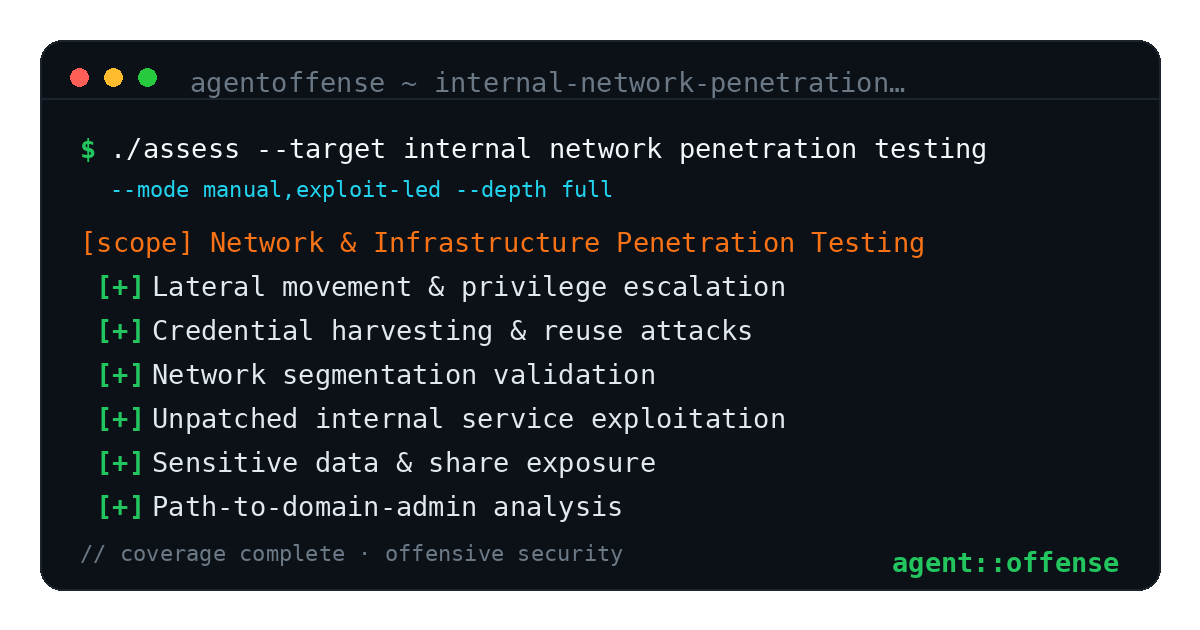
Once an attacker is inside — through phishing, a compromised laptop or a rogue insider — what can they reach? Our internal network penetration testing starts from that assumed-breach position and attempts to move laterally, escalate privileges and reach your most sensitive systems.
We map trust relationships, attack shared credentials and test whether your network segmentation actually contains a breach.
Starting from a realistic assumed-breach position inside your network, our internal penetration testing maps trust relationships, harvests and reuses credentials, exploits unpatched internal services and attempts to move laterally toward your most sensitive systems. We validate whether your network segmentation actually contains a breach and document the full compromise chain — often ending in a clear path to domain administrator — so you can break the most dangerous paths first.
Perimeter defenses eventually fail — through phishing, a compromised laptop or a rogue insider — and the real damage happens next, as an attacker moves laterally toward your most sensitive systems. Flat networks turn a single foothold into total compromise.
Internal network penetration testing measures exactly how far an intruder could go once inside, and whether your segmentation and monitoring would actually contain them.
What we test
Lateral movement & privilege escalation
Credential harvesting & reuse attacks
Network segmentation validation
Unpatched internal service exploitation
Sensitive data & share exposure
Path-to-domain-admin analysis
Common vulnerabilities we uncover
Lateral movement through weak segmentation
Credential reuse and pass-the-hash
Unpatched internal service exploitation
Excessive shares and sensitive data exposure
Weak internal authentication and protocols
Clear paths to domain administrator
Our methodology
Scoping & rules of engagement. We agree objectives, targets and boundaries for your internal network penetration testing, so testing is safe, authorized and focused on what matters to your business.
Reconnaissance & mapping. We enumerate the full attack surface in scope, building a complete picture before any exploitation begins.
Manual exploitation. Our senior testers chain vulnerabilities by hand — going far beyond automated scanners — to prove real, demonstrable impact.
Analysis & reporting. Every finding is triaged, risk-rated with CVSS and written up with a copy-paste reproduction and clear remediation.
Remediation support & free retest. We support your team through the fixes and retest the remediated issues to confirm they are genuinely closed.
Tools & techniques
From an assumed-breach foothold, we use attack-path mapping, credential-harvesting and lateral-movement techniques, validated manually to confirm exploitability. We enumerate hosts, services and trust relationships, attempt pass-the-hash and credential reuse, and test whether segmentation contains movement. Testing is mapped to MITRE ATT&CK and PTES, with a documented compromise chain from foothold to critical systems.
When you need this engagement
To measure how far a breach could spread once inside
For organizations with flat or lightly segmented networks
After deploying new internal systems or segmentation changes
As part of a defense-in-depth or zero-trust validation program
What you receive
Internal attack-path narrative
Compromise chain with evidence
Segmentation and hardening guidance
Free retest after remediation
What’s included in your report
Every internal network penetration testing engagement concludes with a comprehensive, board-ready report and a working session to walk your team through it. Your report includes:
An executive summary with overall risk posture for non-technical stakeholders
Detailed technical findings, each with a step-by-step, copy-paste reproduction
CVSS v3.1 severity ratings and business-impact context for every issue
Prioritized, actionable remediation guidance your engineers can apply directly
A complimentary retest to confirm fixes and update finding status
A formal attestation letter for customers, auditors and compliance programs
Standards & frameworks
PTESMITRE ATT&CKNIST SP 800-115OSSTMM
Outcomes you can expect
After your internal network penetration testing, you will have clear, evidence-based visibility into your real security risk — not a scanner’s guesswork. You will know exactly which weaknesses an attacker could exploit, what the business impact would be, and the precise steps to fix them in priority order. Teams use our findings to close critical gaps, satisfy customer and regulator security requirements, and demonstrate due diligence to their board. With a complimentary retest included, you also get documented proof that the issues are genuinely resolved.
Engagement details & logistics
Every internal network penetration testing starts with a short, no-obligation scoping call to understand your goals, environment and constraints, followed by a fixed-price proposal and a clear statement of work. Most engagements are delivered fully remotely, with on-site work arranged where it genuinely adds value. Throughout testing we maintain an agreed communication cadence and escalate any critical, high-impact finding to you immediately rather than waiting for the final report. All work is performed under a signed NDA with strict data-handling controls, using safe, non-disruptive techniques and carefully coordinated rules of engagement to protect your production systems. On completion you receive your report and a walkthrough session, followed by a complimentary retest once your fixes are in place. Typical engagements are booked one to three weeks in advance, and urgent or pre-deadline testing can often be accommodated — just ask at hi@agentoffense.com.
Why organizations choose AgentOffense
Our internal network penetration testing is delivered by senior offensive-security engineers who test the way real attackers do — manually, creatively and with a relentless focus on proving genuine, demonstrable impact. Here is what sets our engagements apart:
Manual, exploit-driven testing that chains vulnerabilities the way a real attacker would, going far beyond what automated scanners can find.
Reproducible proof for every finding, with copy-paste reproduction steps your engineers can follow and independently verify.
Honest severity calibration so you invest in fixing what genuinely matters and avoid wasting effort on false positives and noise.
Clear, business-focused reporting that speaks to engineers and executives alike, tying every issue to real-world impact.
A complimentary retest included, so you get documented proof that your fixes actually close the attack path.
Responsible, collaborative delivery with a named point of contact and secure handling of all data throughout the engagement.
Explore related services
Internal Network Penetration Testing is frequently scoped alongside our other offensive-security services for broader coverage. Explore related engagements that complement it:
Active Directory Penetration Testing — Active Directory penetration testing — Kerberos attacks, delegation abuse, ACL and privilege-escalation paths to domain admin,…
External Network Penetration Testing — External network penetration testing of your internet-facing perimeter — exposed services, misconfigurations and exploitable hosts, tested…
Assumed Breach Assessment — Assumed breach assessment — start from a compromised foothold to measure blast radius, lateral movement and…
How much does Internal Network Penetration Testing cost?
Every internal network penetration testing is scoped and priced individually, so you pay for exactly the coverage you need — with no hidden extras. After a short, no-obligation scoping call we send a fixed-price quote, usually within one business day, with clear deliverables, a firm timeline and a complimentary retest included. The price of your internal network penetration testing depends on the size and complexity of the target and the depth of testing required, so you always know the cost up front before any work begins.
Usually via a small hardware or virtual implant, or a VPN jump host we provide — no need to host our tooling yourself.
Is this the same as a red team?
No. Internal testing aims for broad coverage of internal weaknesses. A red team is stealthy and objective-driven, testing detection and response as well.
Do you test Active Directory?
Yes, and we also offer a dedicated Active Directory penetration testing service for deeper identity-focused engagements.
How do you access our internal network?
Via a small hardware or virtual implant, or a VPN jump host we provide — you do not need to host our tooling yourself.
Is this the same as a red team engagement?
No. Internal testing maximizes coverage of internal weaknesses; a red team is stealthy and objective-driven, also testing detection and response.
Do you need to install anything on our network?
We use a small hardware or virtual implant, or a VPN jump host we provide — you do not need to host our tooling yourself.
How much does internal network penetration testing cost?
Pricing depends on network size and objectives. Contact hi@agentoffense.com for a scoped, fixed-price quote.
How long does internal network testing take?
Typically one to two weeks depending on network size and objectives, plus a retest window after remediation.
Do you avoid disrupting production systems?
Yes. We coordinate carefully, avoid denial-of-service and destructive actions, and prevent account lockouts throughout the engagement.
// get started
Request Internal Network Penetration Testing
Tell us about your target and goals. We’ll reply with scope and a fixed-price quote — usually within one business day.
./request_engagement
We use only essential cookies needed to run this site. See our Privacy Policy.