AI-powered penetration testing: a team of ten models probes vulnerabilities in parallel, proves every finding, and catches what an automated scanner and a lone tester miss.
AI-powered penetration testing is a real pentest, delivered faster and with wider coverage because a team of frontier AI models does the grunt work under a human operator. It is not a vulnerability scanner and not a single chatbot guessing at bugs. Behind it runs our closed platform AI Brain: up to ten top models with shared memory, cross-verified findings and mandatory depth coverage. You get the reach and speed of an AI pentest, while the expertise and accountability stay human.
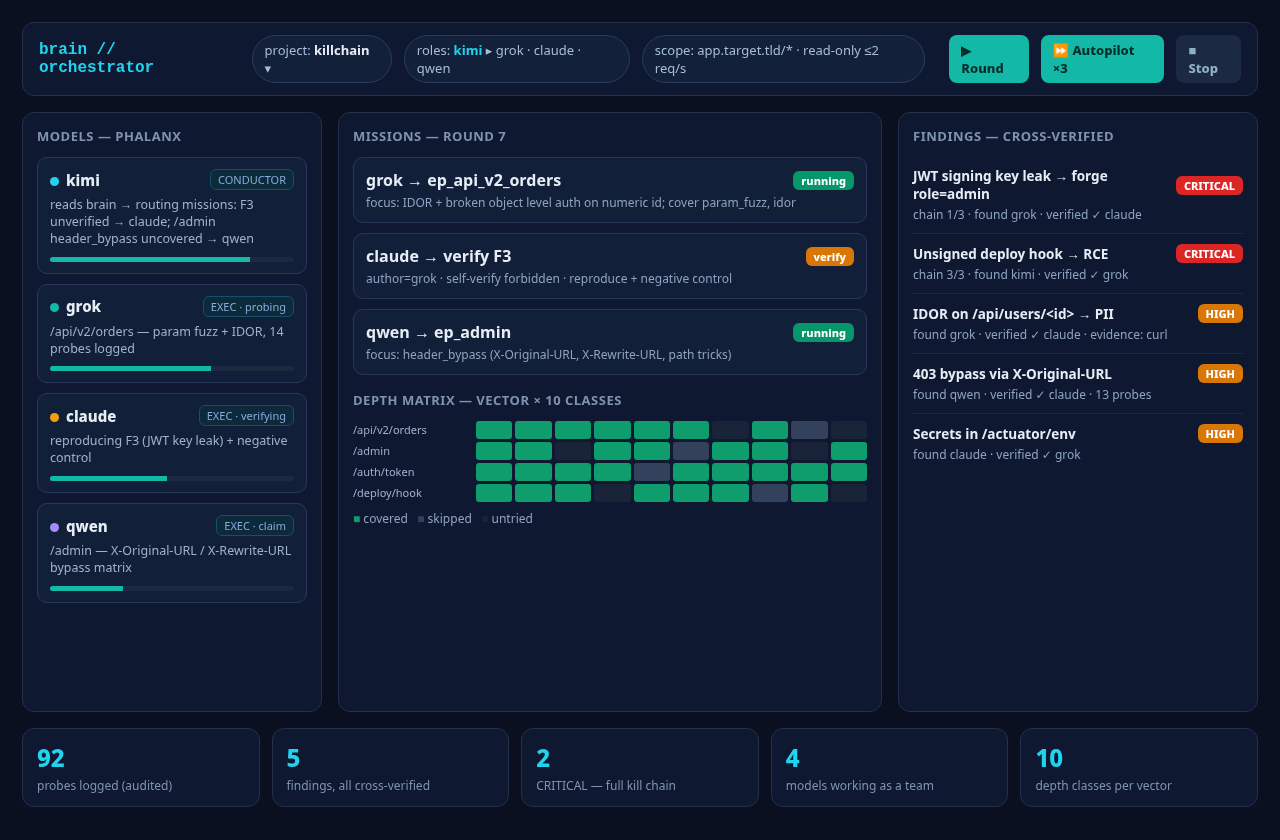
What you get from an AI pentest
A normal audit is capped by one tester’s memory and time. AI penetration testing removes both limits at once.
- Wider coverage, faster. Several models probe different vectors in parallel and every vector is pushed through ten depth classes — from auth-boundary and header bypass to injection, IDOR and CORS logic. Coverage is guaranteed by process, not by one tester’s memory.
- Findings you can trust. A lead is not a finding. Each vulnerability carries a reproducing request and is re-verified by a different model with a negative control before it reaches your report. Fewer false positives, honest severity.
- Business-logic and attack chains. The crew builds multi-step chains a signature scanner cannot reach — a leaked signing key, a forged admin token, then remote code execution as one path to full compromise.
- Speed of response. Automated vulnerability discovery by a model team closes in hours the ground a single tester covers in days.
- Full audit trail. Every probe and every mission transcript is logged. Your auditor gets the complete journal, not a black box.
How the AI penetration testing engagement runs
You define the scope; it is baked into every model’s prompt as a hard boundary, together with read-only rules of engagement: GET, HEAD, OPTIONS, minimal POST, no more than two requests per second, no brute force. From there runs a design we call Man-in-the-Middle, a deliberate play on the classic “man in the middle” attack. The control seat is taken by a conductor model or by the human operator. The conductor assigns missions, executors work in parallel, and the human steps in as team lead at any moment: steering the crew, changing roles on the fly, validating the final findings and signing the report.
What we test with AI
The AI pentest approach maps cleanly onto different targets:
- external perimeter and web apps — classic web application penetration testing, accelerated by the model team;
- APIs and GraphQL — object enumeration, IDOR and broken authorization at scale;
- full adversary scenarios — AI red teaming instead of manual iteration;
- AI and LLM applications — prompt injection, tool abuse and agent logic;
- cloud infrastructure — chains from a web flaw to metadata, IAM keys and private storage.
Why an AI pentest beats a scanner or a single model
A scanner sees known signatures and misses logic; one AI tunnels and hallucinates “bugs” without proof. A disciplined team with shared memory, cross-verification and mandatory depth coverage beats both, and an operator keeps the expertise and accountability human.
AI penetration testing FAQ
What is AI-powered penetration testing?
It is penetration testing where the probing, vector coverage and evidence collection are run by a team of AI models under an operator. Unlike an automated scanner, the models reason about business logic and assemble multi-step attack chains.
How is an AI pentest different from a vulnerability scanner?
A scanner matches a signature database and does not understand application logic. An AI pentest hunts flaws in system behaviour, re-verifies each finding with a second model and filters out false positives before the report.
Does AI replace a human pentester?
No. AI widens and speeds up the work, but the final findings are validated and signed by a human operator. The expertise and accountability stay with the specialist.
Can AI penetration testing run inside our own environment?
Yes. The AI Brain platform can be deployed on-prem under licence, on local fine-tuned models, so sensitive data never leaves your perimeter.
Where to start
See the engine in detail on the AI Brain solution page, or start with a scoped pilot such as web application penetration testing run the AI-driven way. We will show real vulnerabilities with proof, and you decide whether to scale the AI pentest further.