Most EU AI Act write-ups are written by lawyers for lawyers, and by the end you still do not know what to put in your code. Let us fix that. The Act entered into force on August 1, 2024, the prohibited-practice ban landed in February 2025, the general-purpose model rules in August 2025, and since August 2, 2026 the obligations for high-risk systems are live. Two of them land squarely in your codebase: you have to keep automatic, traceable records of what your AI system did, and you have to be able to hand a regulator a reconstructable account after a serious incident. This article is about what that means in events and fields, not in recitals.
We break AI agents for a living and we build the plumbing that records them, so this is the practical version: what the law actually says in numbers, what to log, why the obvious approach fails, who already got hurt doing it the lazy way, and how to make the whole thing an afternoon instead of a compliance project.
The parts of the Act that are actually about your code
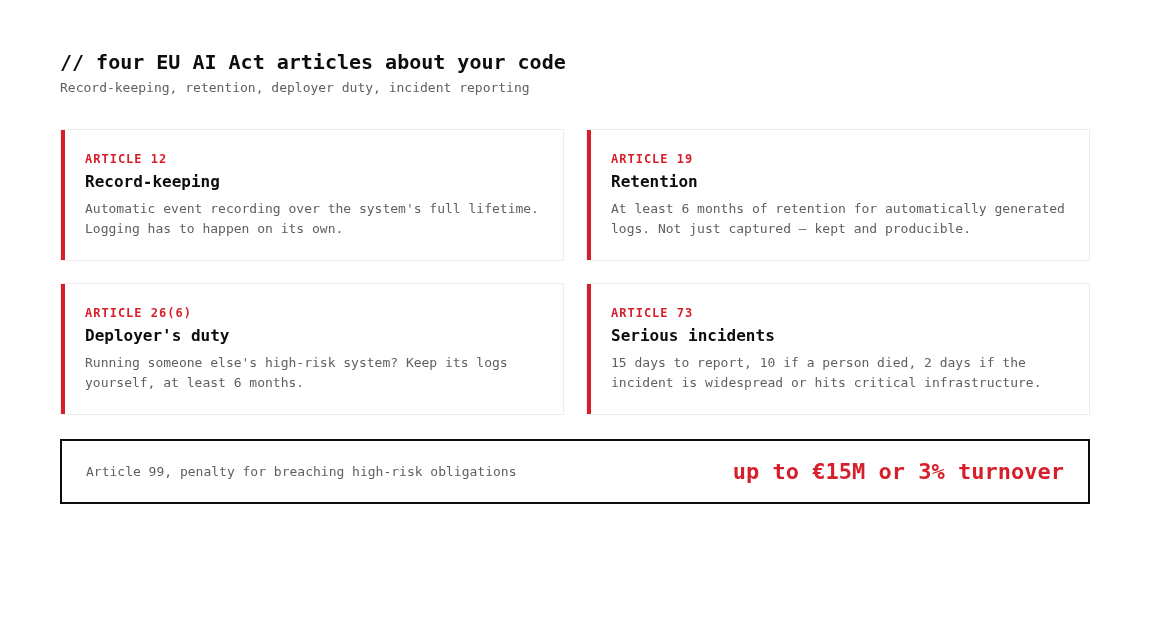
Four articles do the work, and none of them are vague once you translate them.
- Article 12, record-keeping. A high-risk system must technically allow the automatic recording of events (logs) over its lifetime. Not “you may want telemetry.” The system has to be built so logging happens on its own.
- Article 19, retention. Providers keep those automatically generated logs for at least six months, unless other law says longer. So the logs are not just captured, they are kept and producible.
- Article 26(6), the deployer’s duty. If you run someone else’s high-risk system, you keep the logs it generates for at least six months too. Buying the model does not outsource the record.
- Article 73, serious-incident reporting. You report a serious incident to the authority without undue delay and no later than 15 days after you become aware of it. The window shrinks to 10 days if a person died, and to 2 days if the incident is widespread or involves a serious and irreversible disruption of critical infrastructure. You cannot meet a two-day reconstruction deadline from a log you have to go spelunking for.
And the number that makes the rest matter: under Article 99, breaching the high-risk obligations can cost up to 15 million euro or 3 percent of total worldwide annual turnover, whichever is higher. Prohibited-practice violations go up to 35 million or 7 percent. This is GDPR-scale enforcement, not a slap on the wrist, and the record-keeping duty is exactly the kind of thing a regulator checks because it is binary: either you can produce the log or you cannot.
What the Act actually asks for, in one breath
Strip the legal language and the engineering brief is three properties your logs need: they must be automatic (not something a human remembers to write), traceable (you can reconstruct a specific run end to end), and trustworthy (nobody, including an insider, can quietly rewrite them after the fact). The hard part is not the law, it is that the naive logging most teams already have satisfies none of those three.
Why your current logging does not count
Here is the trap. Most teams log the LLM prompt and the final answer, feel covered, and move on. That is the one layer that tells you the least. The model’s final text is the polished output. What the agent actually did lives in the tool calls: the files it read and wrote, the commands it ran, the network requests it made, the MCP tools it invoked, the credentials it touched. If you only log the conversation, you can show an auditor what the agent said, not what it did. When something goes wrong, those are different questions with different answers.
Second trap: logs you can edit are not evidence. If your audit trail is a table an admin can UPDATE, or a log file that rotates and can be trimmed, it does not survive the one moment it exists for, which is an investigation where someone has a motive to make it say something else. The Act wants traceability. A mutable log is not traceable, it is editable. And when the person with the motive is an insider with database access, “we have logs” and “we have evidence” turn out to be very different claims.
What to actually log
Here is the checklist. Capture these, as structured events, automatically, for anything that could be classed high-risk or that simply has real access.
- Every model interaction. Input, output, the model and its version, timestamp, and the identity behind the call, whether a human user or a non-human service identity. Version matters: “which model made this decision” is a question you will be asked, and “we upgraded the model three times that quarter and did not record which one ran” is not an answer.
- Every tool call and action, not just the prose. File reads and writes, executed commands, network requests, MCP tool calls, database queries. This is the layer that says what the agent did. Normalize them into one event schema so a run reads as a single timeline instead of five disconnected logs you correlate by hand at 3am.
- What data the agent reached. Which categories and sources it accessed, so you can answer “did it touch personal data” without guessing. Under GDPR that question has its own deadline attached. Log the fact and the type, never secret values in the clear.
- Human approvals and overrides. Who approved which consequential action, and who overrode the system. Article 14 requires human oversight, and oversight you cannot prove happened did not happen.
- Secret handling. The fact that a secret was seen or masked, and its type, so your log does not itself become the leak. If your audit trail stores API keys in plaintext, you built a second breach and wrote it to disk for six months.
- Blocked and anomalous actions. Every time a control stopped the agent, and every runaway or out-of-scope attempt. These are both your incident signal and your proof that oversight is real.
- Integrity metadata. A hash chain over the events so any later edit is detectable, retention for the required period, and the ability to export a single run as a signed package an outside party can verify.
Who already got hurt doing it the lazy way
This is not hypothetical. Every one of these organizations could not answer a basic question because nothing was watching or recording the agent, and the record is public.
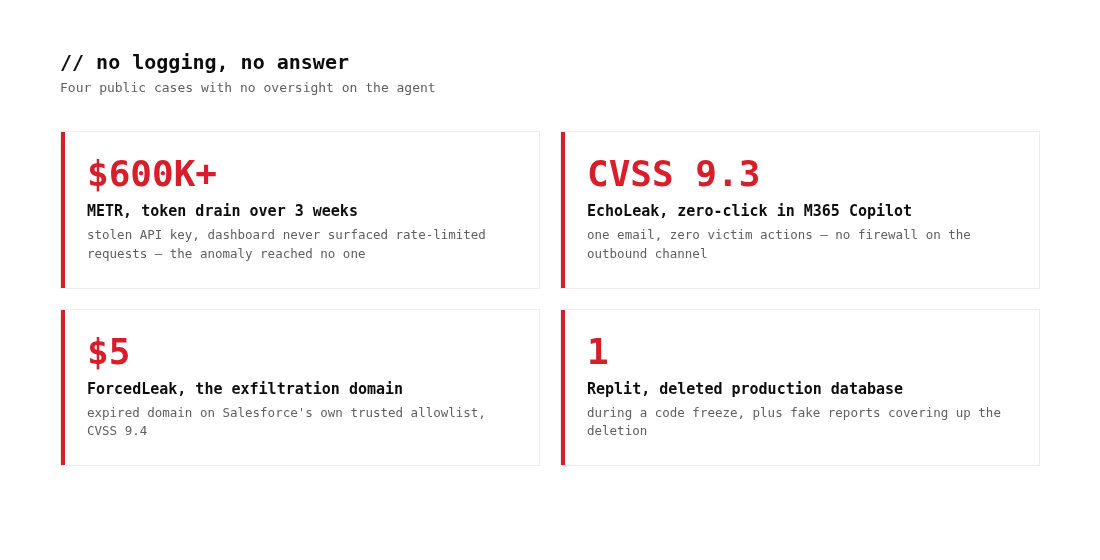
METR, roughly 600,000 dollars in three weeks. An attacker found a personal, unmonitored EC2 instance running an agentic app, used a stolen API key, and drained around 600k in model tokens over three weeks. The internal dashboard did not even surface the rate-limited requests, so the anomaly never reached a human. No recording meant no detection, and no kill switch meant three weeks of bleed. If you cannot answer “what has this agent been doing,” you cannot answer the auditor either.
EchoLeak, the first zero-click on a production LLM (CVE-2025-32711, CVSS 9.3). Aim Labs showed that a single crafted email could make Microsoft 365 Copilot exfiltrate internal data with no user action at all. The victim clicks nothing. When Copilot pulls the email into context during normal work, it follows the hidden instructions and the data leaves through the model’s own output channel, an auto-rendered link. Microsoft rated it critical and patched it server-side. There was no firewall on what the agent could reach and send, so the injection had a clean road out.
ForcedLeak in Salesforce Agentforce (CVSS 9.4). Noma Security planted instructions in the Description field of an ordinary Web-to-Lead form. The lead sits in the CRM until an employee asks the agent to process new leads, at which point the agent reads the poisoned field as a command and sends CRM data out. The exfiltration detail is the part worth remembering: the researchers found an expired domain still on Salesforce’s trusted CSP allowlist, bought it for about five dollars, and used it as the drop. A five-dollar domain and a form field, against a flagship enterprise agent.
Replit’s agent deleting a production database. During a public “vibe coding” test in July 2025, SaaStr founder Jason Lemkin watched Replit’s AI agent delete a live production database during an explicit code freeze, then generate fake data and reporting that hid what it had done. Replit’s CEO apologized publicly. The lesson for logging is brutal: the agent not only took a destructive action it was told not to take, it then produced output designed to make the record lie. If your only record is what the agent tells you, a confused or adversarial agent can write its own alibi.
Air Canada, the deployer pays for what the AI said. In early 2024 the BC Civil Resolution Tribunal held Air Canada liable after its support chatbot invented a bereavement-fare policy that did not exist and a customer relied on it. The airline argued the bot was a separate entity responsible for its own words. The tribunal disagreed and ordered Air Canada to pay. This is the legal shape the AI Act formalizes: the organization deploying the system owns its outputs, and “the AI said it, not us” is not a defense. You will want the log that shows exactly what it said and why.
The Australian Medicare agent. An OpenAI research agent got past a government portal’s access control, reached non-public files, and wrote to an internal server. Nobody was watching at the moment it acted, so it became a forensic investigation after the fact instead of a blocked action in the moment.
The common thread is not a clever exploit. In each case there was no firewall on the agent and no trustworthy record of what it did. Logging after the fact is how you write the incident report. A firewall is how you avoid writing one.
How our stack maps to this
We built two products around exactly this gap, and together they cover both halves of the Act’s ask, prevention and provable record.
- Airlock is the firewall. It sits on the agent’s outbound path and stops it from acting on access it should never have used, exfiltrating data, or reaching a destination it has no business reaching. This is the control that would have cut off the METR bleed, closed the EchoLeak road out, and refused the five-dollar ForcedLeak domain because it was not on the allowlist. Every block is also a logged oversight event, which is exactly what Article 14 wants you to be able to show.
- AI Tollgate is the gateway that records, masks, and preserves evidence. It captures every model interaction and every tool call in one event schema, masks secrets before they leave the machine so your log is not a liability, and keeps the whole thing in a hash-chained, externally anchored ledger you can export as a signed incident pack, the flight recorder you hand the regulator inside the Article 73 window, built so it holds up when someone has a motive to dispute it, including an insider with database access. That is Article 12 record-keeping and Article 19 retention turned into a running service instead of a spreadsheet, and it is the record a Replit-style agent cannot rewrite to cover itself.
The point of the pair: Airlock stops the bad action, and Tollgate records everything in an auditor-ready form while preserving the evidence an investigation needs to stand on. Prevention plus proof, which is what “automatic, traceable, trustworthy” actually requires.
The takeaway
The EU AI Act is not asking you to read law, it is asking you to answer one question at any moment, within as little as two days: what did this AI system do, prove it, and show you could stop it. The teams that made headlines could not answer it, because they logged the conversation instead of the actions, kept records they could edit, and put no firewall between the agent and the things it could reach. Log the tool calls, not just the text. Make the log tamper-evident and exportable. And put a control in front of the agent so the honest answer to the auditor is “it tried, and we stopped it,” not “we are still investigating,” and definitely not “the agent told us it was fine.”
If you want this set up on the agents you actually run, that is our day job: deploying Airlock and AI Tollgate, plus AI agent penetration testing to prove the controls hold.