AI security scanner development means an AI-based vulnerability scanner we build for your specific infrastructure. Instead of a one-off test, our AI Brain engine and an ensemble of several AI models first map your entire attack surface — every entry point and technology in use — and then keep watching it: hunting fresh vulnerabilities as they appear and picking up the capabilities of new AI models, which ship almost every month.
How it differs from a regular vulnerability scanner
A classic vulnerability scanner matches your systems against a database of known signatures. Useful, but it has a ceiling: it does not reason, it is weak on logic flaws and chains of small issues, it runs the same rules for everyone, and it knows nothing about the specifics of your stack.
Our approach is different. The scanner is built for your exact infrastructure, reasons over findings like an attacker, and gets smarter as new AI models are released. This is not another off-the-shelf tool — it is an instrument tuned to you that does not go stale the next day.
How we do it
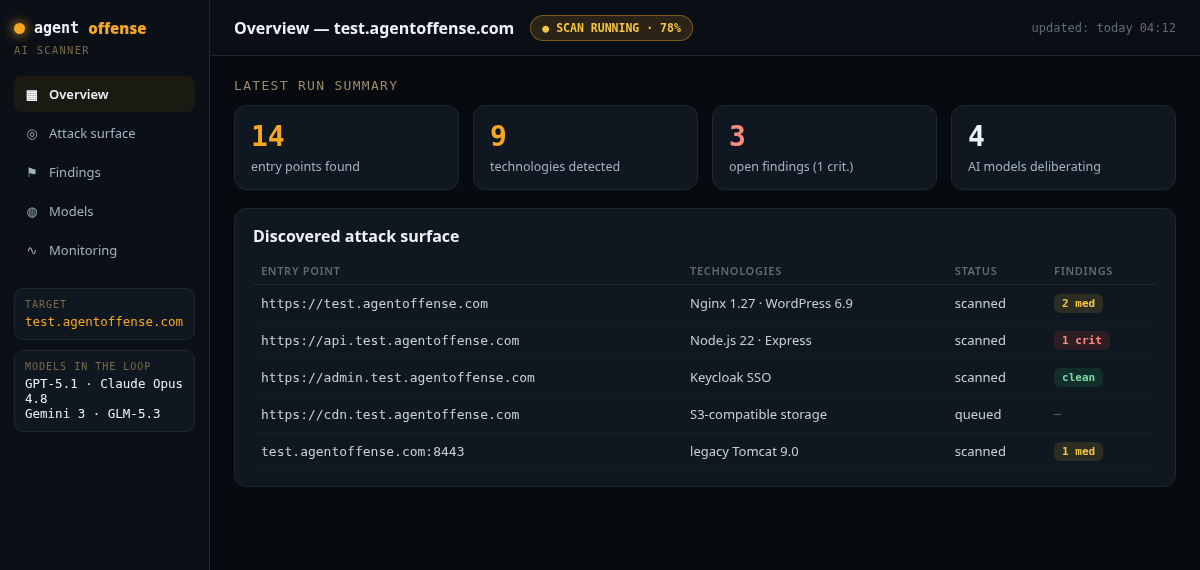
- Map the attack surface. We scan your infrastructure and find every entry point, service and technology — what is actually reachable from the internet and where. This is external attack surface management (ASM/EASM) in practice: without an honest map, any scanner misses.
- Build the scanner for your stack. From that map we assemble it on several AI models, tuned to your technologies rather than a one-size-fits-all ruleset.
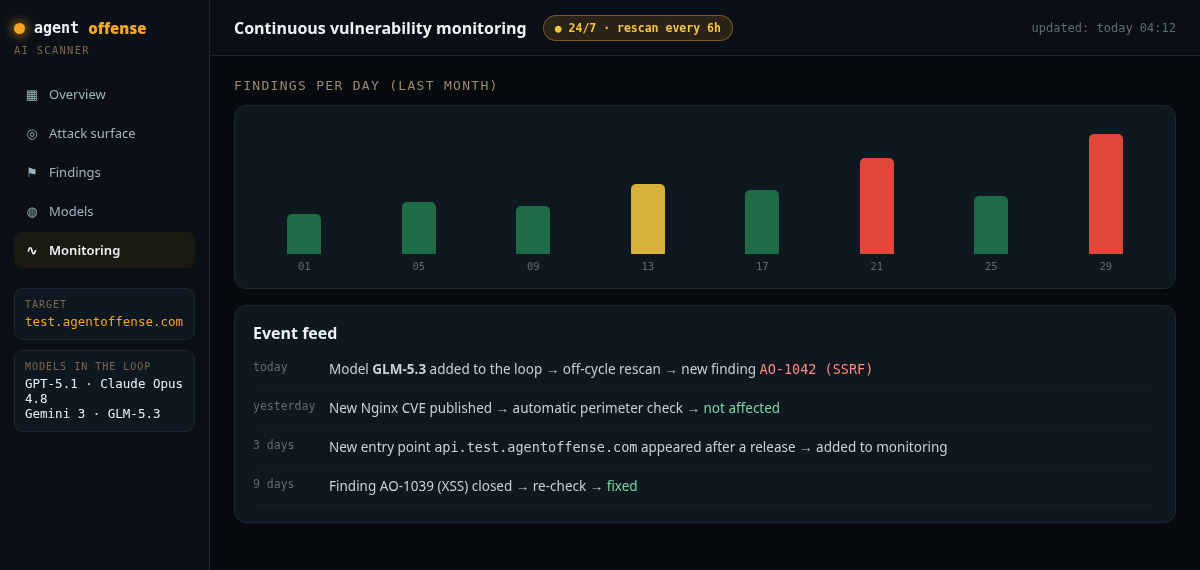
- Run continuous vulnerability monitoring. It keeps your infrastructure under watch and re-checks it on a schedule for new vulnerabilities — not once a year.
- Update it for new models. AI models ship often and keep getting more capable, so we keep the scanner on the current ones, so it catches what it could not see yesterday.
Why several AI models, not one
Over the past year we have run more than 200 ethical hacking engagements, including with AI acting as the operator rather than an assistant. The finding is simple: as a vulnerability analyst, different models behave very differently. One spots what another misses; each has its own strengths and blind spots.
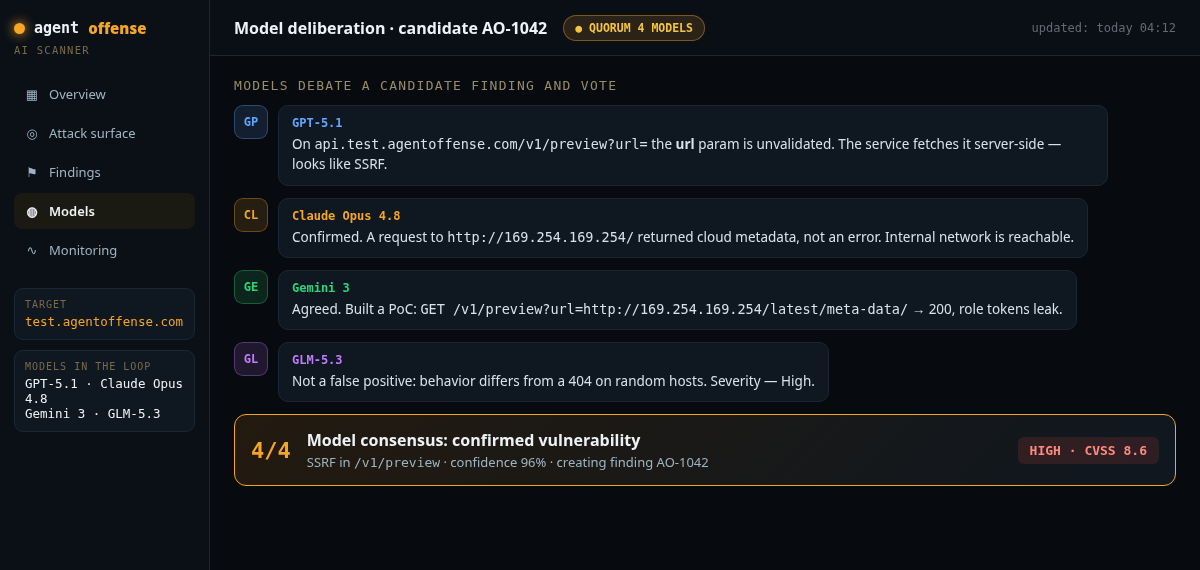
So the scanning runs on an ensemble of models. Before a finding is raised, the models effectively deliberate and reach consensus — which sharply cuts false positives. And as stronger models arrive, we add them to the loop and quality improves without rebuilding everything from scratch.
What the scanner looks like in action
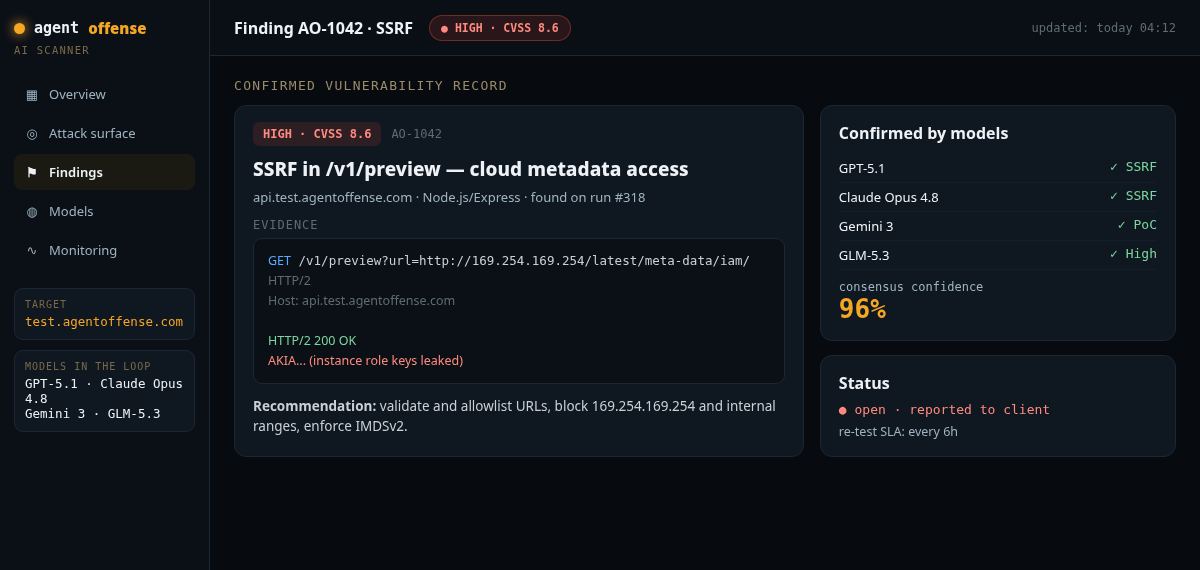
Below is a demo of the dashboard on our own test range, test.agentoffense.com: from the attack-surface map to the moment several AI models deliberate and confirm a vulnerability.
What the scanner finds
- New vulnerabilities in your exact technologies, as soon as they become known.
- Misconfigurations and insecure service settings.
- Forgotten and newly appeared entry points that show up with every release and infrastructure change.
- Weak points at the seams between systems, and chains of small issues a signature scanner ignores in isolation.
What you get
- A map of your attack surface: entry points, services, technologies.
- Your own AI vulnerability scanner, tuned to your infrastructure.
- Continuous monitoring and vulnerability management: regular reports and alerts on new risks, prioritized.
- Support and updates for the scanner as new vulnerabilities and new AI models appear.
Who it is for
The service is most valuable where infrastructure changes fast: frequent releases, cloud and SaaS, many services and integrations. If an annual penetration test is not enough and you need continuous control rather than a one-time snapshot, an AI scanner closes exactly that gap.
Our engine
The service runs on AI Brain, the same engine we use for automated penetration testing. It maps the attack surface and orchestrates the ensemble of models during scanning. Where your own AI agents are in the loop, they are additionally shielded by our runtime firewall Airlock.
Related services
An AI scanner pairs well with external network penetration testing, AI agent penetration testing and LLM application penetration testing.
Pricing and getting started
The cost of AI security scanner development depends on the size of your infrastructure, the number of technologies and the depth of monitoring, and it is fixed up front with no hidden fees. To scope an AI vulnerability scanner and get an exact quote, get in touch — we will consult for free, agree the boundaries and price it to your budget and timeline.