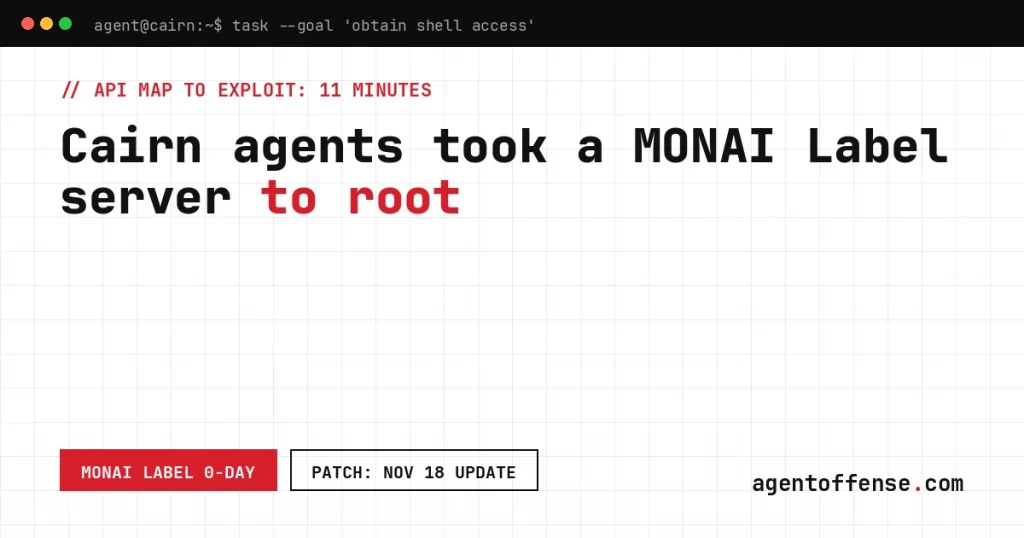
A suspected Chinese-nexus operator used Cairn, a multi-agent penetration-testing platform, to find and exploit a zero-day in the open-source medical imaging tool MONAI Label, according to Amazon Threat Intelligence. The agents went from API mapping to a working exploit in 11 minutes and later took the server to root. Maintainers patched the Cairn MONAI Label zero-day on November 18, 2026; as of publication, no CVE or fixed version number has been published. Any instance reachable from untrusted networks needs the update and a compromise check.
Key takeaways
- Cairn agents exploited a MONAI Label path-traversal zero-day 11 minutes after mapping its API, during a September 8-10, 2026 campaign Amazon tracked.
- A later session reached root via a reverse shell in Python's sitecustomize.py; the same agents failed on a 16-hour Redis attempt and a 30,000-plus-combination brute force.
- The fix shipped November 18, 2026; as of publication, no CVE or version number has been published.
- Chinese-nexus attribution is moderate confidence. The campaign surfaced through the operator's unauthenticated Cairn console.
What did Amazon say Cairn did to MONAI Label?
Amazon says the operator ran Cairn between September 8 and 10, 2026, mostly against educational institutions in East Asia outside China. It names no victims and gives no count.
Cairn is not malware. It coordinates multiple AI agents for offensive work and was built for research and defense, the same dual-use category as the C2 frameworks your red team licenses. The reported instruction was “obtain shell access,” and the agents worked out the rest.
On a reachable MONAI Label server they found a path-traversal flaw: the application did not confine file paths to their intended directory, so an attacker could write files anywhere.
How fast did the Cairn MONAI Label zero-day land, and where did the agents fail?
Eleven minutes passed between the agents mapping the API and exploiting the flaw. Most triage queues take longer to assign a ticket.
Root came in a follow-on session. The agents wrote a reverse shell into Python’s sitecustomize.py, which loads every time an interpreter starts, then called an API endpoint to trigger it. Amazon did not say whether MONAI Label required authentication or what privileges the service held.
Then the human stepped back in, supplying a proxy into a second university network running the same software. A person picks the targets; the agents grind through them.
- A 16-hour, 148-action attempt to take over a Redis server got nowhere.
- Six hours and more than 30,000 credential combinations against a university GPU server, roughly 80 a minute, also failed.
The agents are fast on logic flaws in exposed APIs and mediocre at brute force. Their edge is patience: no analyst sits on one Redis box for 16 hours.
Why was the operator console the detection path?
Amazon found the campaign because the attackers left their Cairn instance publicly reachable with no authentication, exposing prompts and operational details.
Orchestrators store prompts, task state, tool calls and output so agents can coordinate and resume. That is a full operations log: targets, findings, harvested credentials. Amazon also published two IP addresses; pull them from its report, since we do not reprint indicators.
Your own agent platforms carry the same risk. Amazon’s decoys have already caught agents raiding exposed LLM gateways for API keys, and an open orchestrator is a richer prize. Require authentication, restrict network reach, log tool calls and rotate anything that sat in prompts. We test these control planes in AI agent penetration testing.
How confident is the Chinese-nexus call, and who else uses Cairn?
Moderate, and Amazon says so. The assessment rests on prompt language, activity timestamps and target selection: soft signals. Prompt language is easy to fake, and working hours only narrow a time zone. Amazon names no group and claims no state sponsorship, so a “Chinese APT” headline outruns the evidence.
Two other reports exist. In September 2026, Gambit Security documented Cairn abuse in a large-scale payment-card theft operation, and Google more recently reported Cairn used against a U.S. aerospace organization. Three separate operators, one tool: a capable agent platform lowers the skill floor for each.
What should imaging labs and universities do now?
Patch first, then treat anything exposed before November 18 as possibly compromised.
- Patch. Apply the November 18 update and confirm in the release notes that your build includes the fix.
- Preserve before you rebuild. Snapshot the disk or container and export logs; upgrading can erase evidence.
- Hunt on behavior, not two IPs. Look for traversal sequences in request logs, file writes outside upload directories, and shells spawned by the service process.
- Inspect sitecustomize.py and usercustomize.py in the service’s Python environment. A file nobody on your team put there is a finding.
- Check egress. Reverse shells dial out, so watch outbound flows to unfamiliar hosts.
- Scope the data. DICOM files can carry patient identifiers: special-category data under GDPR Article 9, with HIPAA exposure depending on your institution’s role.
From our engagements: research apps on university networks are the systems nobody owns. A lab stands one up on a GPU box and it never makes the asset inventory. An external network penetration test finds them faster than a policy memo, and a manual investigation cycle loses an 11-minute race.
FAQ
What is Cairn?
A legitimate platform that coordinates multiple AI agents for penetration testing and security research. Abused here, it is dual-use software, not malware.
What is the MONAI Label vulnerability Amazon reported?
A path-traversal flaw that let attackers write files anywhere on the server, chained with Python startup behavior to reach root. As of publication, no CVE has been published.
How fast did the AI agents exploit MONAI Label?
Eleven minutes from mapping the API to exploiting the flaw; root came in a later session.
Did Amazon attribute the Cairn campaign to China?
To a Chinese-nexus actor, with moderate confidence, based on prompt language, timestamps and target selection. It named no group or state sponsor.
Attackers now point agents at your exposed services; agent::offense points ours first, under a human operator. Our AI-powered penetration testing finds the forgotten research box before someone else’s Cairn does.