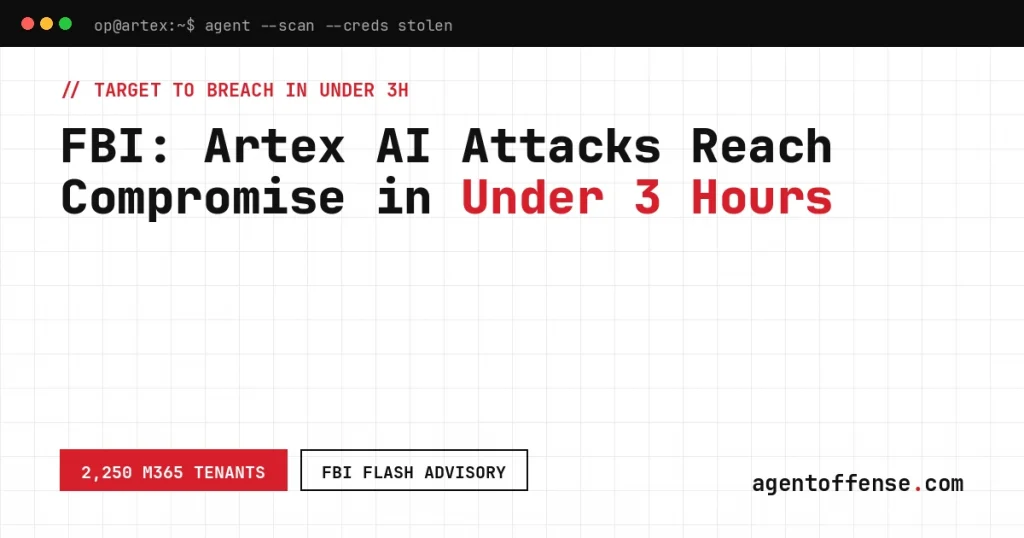
The FBI warned in a flash advisory that attackers are breaching U.S. and foreign networks with the Artex AI hacking tool, an open-source autonomous pentest agent, and that some intrusions went from targeting to active compromise in under three hours. Named victims include ConnectWise, whose breach reached the Microsoft 365 environments of at least 2,250 customers, Barracuda, and South Korean financial institutions that lost data on at least 68,000 people. The earlier open-source build still circulates, so anyone with an unrevoked credential or a login without MFA is in range.
Key takeaways
- The FBI says some Artex-linked intrusions reached active compromise within three hours of targeting.
- Artex can run on hosted Anthropic and OpenAI models or on open-source and non-U.S. models.
- The ConnectWise breach reached Microsoft 365 environments of at least 2,250 customers; Microsoft assesses the operators as likely Chinese.
- Barracuda's separate breach began with an unrevoked third-party credential and ended in a full customer-credential rotation.
What did the FBI say about the Artex AI hacking tool?
The FBI says attackers in the U.S. and abroad are running autonomous AI penetration-testing platforms against real targets, with Artex as its main example. Operators can connect Artex to hosted frontier models from Anthropic and OpenAI, or to open-source and non-U.S. models. The FBI did not say which models, and public reporting gives neither the advisory’s number nor its issue date.
Targets over recent months include financial services, government, technology, defense, telecom and internet providers, and law firms. Artex first appeared publicly in July, and the FBI links it to several attacks since. The fastest went from targeting to active compromise in under three hours, a figure the FBI attaches to some cases, not all.
Initial access is still passwords and missing MFA
Nothing in the advisory describes a new exploit. Artex scans quickly, finds weak protections, and logs in with exposed or stolen passwords. From that foothold it spreads toward databases, mailboxes and other sensitive data. The FBI’s public description stops there: no lateral-movement technique, no credential-dumping method.
South Korea shows the pattern. Several financial institutions fell largely because of weak defenses and missing multi-factor authentication, and personal data on at least 68,000 people was stolen. The reporting names none of the institutions. The bugs are old; the effort needed to find and exploit them across hundreds of targets is what dropped.
The operators are sloppy too. Last week researchers found hundreds of Artex instances online without a password, including the one used against South Korea.
What did Artex reach at ConnectWise?
The FBI confirmed Microsoft’s earlier finding that attackers used Artex to break into ConnectWise, then reached customers’ Microsoft 365 environments and stole data from them. ConnectWise sells IT management software to service providers, so a foothold there inherits trust customers granted on purpose. How the attackers first got in has not been described publicly.
Microsoft assesses the operators as likely Chinese; that is Microsoft’s assessment, not a formal U.S. government attribution. ConnectWise did not respond to TechCrunch’s request for comment. If an MSP holds delegated access to your tenant, list what it can touch and check whether you would see it abused. Our write-up on Entra ID attack paths shows where that access usually leads.
Why did Barracuda rotate every customer credential?
Barracuda rotated every customer credential because its logs could not prove the attackers had stayed out. Its breach was a separate Artex-linked intrusion, this time by financially motivated criminals.
It began with a credential for a third-party service that Barracuda never revoked after ending work with the vendor. That access reached the credential stores Barracuda uses to collect data from customer systems. With telemetry too thin to rule out access, the company chose to “assume the worst” and changed all customer credentials.
A spokesperson said it “directly notified and advised a minority of XDR customers to revoke and recreate integration credentials,” without giving a number. An assumed breach assessment that starts from a single integration credential measures that blast radius before a real attacker does.
Why does the FBI call these intrusions noisy?
Artex throws off enough traffic and data to trip a victim’s alerts. Noise gives defenders a detection chance, and it also floods a small SOC during the hours that decide the outcome. Barracuda CISO Arve Kjoelen put it plainly: “Defenders who rely on spotting malicious activity and then responding to it will often arrive after the attacker has finished.”
Public reporting lists no CVEs, hashes, IP addresses or domains, so a rule keyed to the name Artex catches nothing. Alert on behavior: scanning bursts, failed logins followed by a success, fast directory or mailbox enumeration, unusual Microsoft Graph volume, and bulk downloads soon after a new foothold.
The developer has since made Artex closed-source, but the FBI says the earlier open-source version remains “widely accessible.” Plan as if it never goes away.
What should security leads check this week?
Start with the controls the named victims failed.
- Vendor and integration credentials. Each needs an owner and explicit revocation when the contract ends.
- MFA coverage. Find login paths still without it, including legacy protocols and service endpoints.
- MSP access to Microsoft 365. Review delegated admin rights, OAuth grants and service principals your providers hold.
- Response authority. Pre-approve containment, such as disabling an integration identity, so the SOC can act within the hour.
Then test at attacker tempo. An AI-powered penetration test run under a human operator shows whether your SOC pages someone before hour three or reads the alerts the next morning.
FAQ
What is the Artex AI hacking tool the FBI warned about?
An open-source, AI-powered penetration-testing platform that connects to hosted Anthropic and OpenAI models or to open-source and non-U.S. models. Attackers use it to scan, break in and move through networks.
How fast can Artex go from targeting to compromise?
In some cases, under three hours, according to the FBI. That figure describes some intrusions, not an average.
What happened in the Barracuda Artex attack?
Criminals used a third-party credential Barracuda never revoked and reached credential stores used to collect customer data. Its logs could not rule out access, so Barracuda changed all customer credentials.
Is Artex still open source?
No. The developer closed the source after the attacks, but the FBI says the earlier open-source version remains widely accessible.
agent::offense runs pentests with the same class of agentic tooling attackers now use, under human operators. See how AI Brain finds stale credentials and MFA gaps before someone else’s agent does.